
Written and medically reviewed by Dr. Kamen Ng. Last reviewed 2026-10-29. 15 min
By Dr. Kamen Ng · Head of Aesthetic Medicine, AOKLINIK
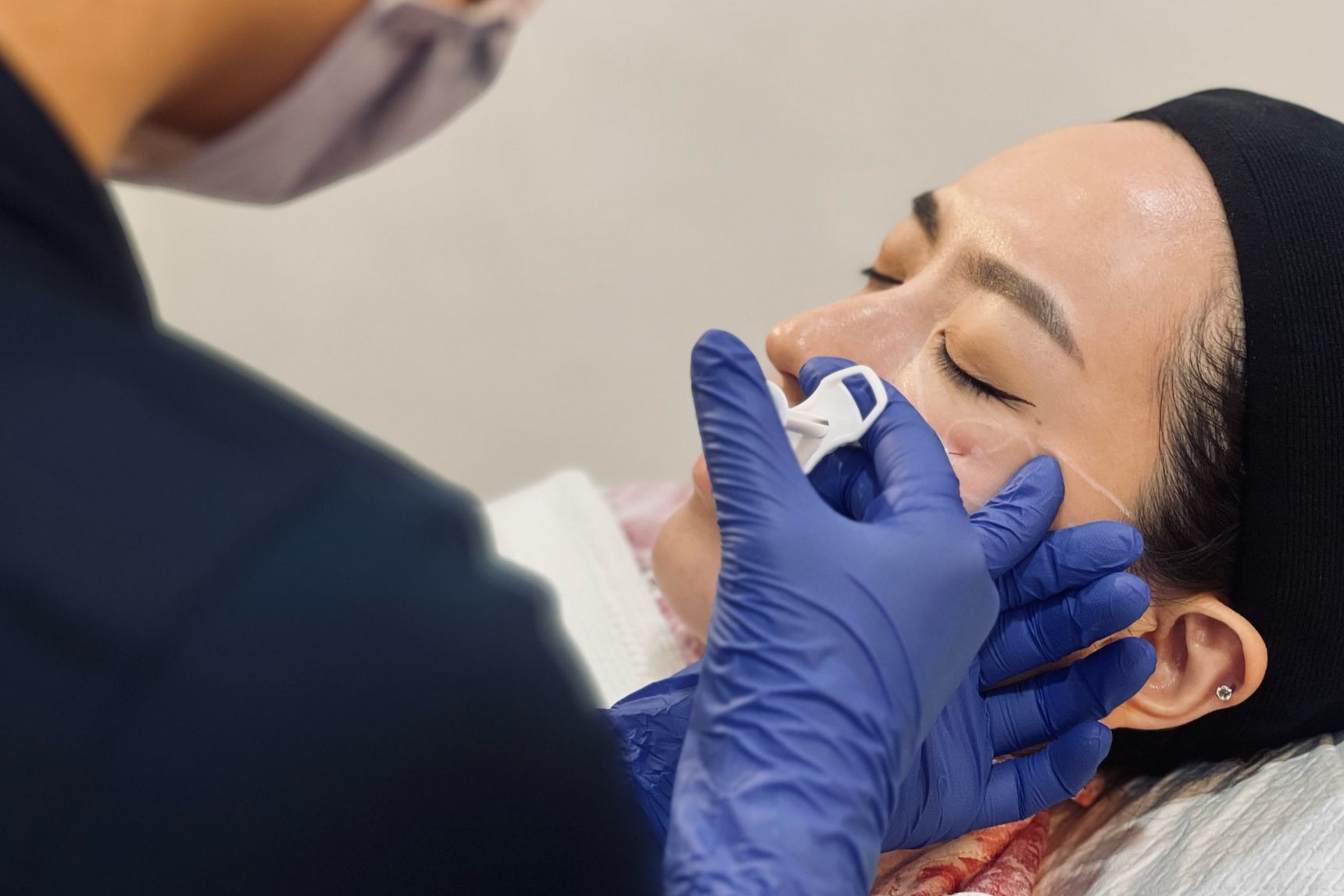
The word lift is doing a great deal of work in aesthetic medicine, and most of it is unearned.
A surgeon lifts by releasing tissue, repositioning it along a chosen vector and removing what is left over. No injectable does any of those three things. What an injectable can do is restore the support that tissue used to sit on, so that it holds itself differently. Those are not the same operation, and the difference is the honest subject of this article.
Calcium hydroxylapatite, CaHA, is the material I reach for most often when the problem is lost structure rather than lost volume. I want to explain why, what the material actually is, where it goes, what it feels like to have done, and where the claims around it exceed the evidence.
We have written separately about CaHA against hyaluronic acid fillers, about hyperdiluting it for skin quality, and about how it compares with Sculptra and HArmonyCa. This one is about the opposite use: undiluted, deep, on bone, for structure.
What the material is
CaHA is the principal inorganic component of human bone and teeth. The injectable version is synthetic, and in the formulation most widely used it consists of microspheres of 25 to 45 micrometres, making up around 30 per cent of the product, suspended in an aqueous gel carrier containing glycerin and sodium carboxymethylcellulose.
It is biocompatible, biodegradable, non-mutagenic and non-antigenic, which in practice means no allergy testing is required before treatment.
Two phases, and this is the key to understanding it
Phase one, the carrier. The gel provides immediate volume on the day. It is also what makes the product mouldable for the first short period after injection. That gel then resorbs over the following weeks.
Phase two, the microspheres. As the carrier leaves, the microspheres remain as a scaffold. Fibroblasts populate that scaffold and lay down new collagen around it. A pilot study using diluted preparations with biopsies out to seven months reported significant increases in type I and type III collagen against baseline, along with increased elastin, with type III declining after about seven months, which is consistent with a maturing rather than a failing response.
So what you see at three months is substantially your own tissue, built on a scaffold that is itself being broken down. That is a genuinely different proposition from a gel occupying space.
One practical property worth knowing. CaHA is considerably less hygroscopic than hyaluronic acid, meaning it does not draw water into the tissue. It therefore swells far less, which matters for anyone who has had a filler treatment and spent a fortnight waiting for their face to settle.
Why its mechanical behaviour suits lifting
Rheology is the property that decides what a product is good for, and it is more useful than any brand comparison.
CaHA has a high elastic modulus, commonly written as G prime. In plain terms it resists deformation. Placed as a bolus on bone it holds its shape against the weight and movement of the tissue above it, rather than spreading out under pressure.
That is precisely what you want from a structural material and precisely what you do not want from something intended to integrate softly into mobile tissue. It is also why CaHA has no place in the lips, and why I do not use it in the tear trough.
What it is formally approved for
Worth stating, because it anchors the discussion.
Beyond its longer-standing indications for nasolabial folds, the dorsum of the hands and facial lipoatrophy, the lidocaine-containing formulation received FDA approval in September 2021 for improvement of moderate to severe loss of jawline contour in adults over 21, by deep subdermal or supraperiosteal injection.
The pivotal study randomised 180 subjects aged 26 to 65 with evaluator blinding, and reported that 75.6 per cent achieved at least a one-point improvement on a jawline assessment scale on both sides at week 12, with no treatment-related serious adverse events and the commonest events being mild transient injection site reactions, across a 60-week study.
I cite that not as a promise of your result but because a randomised evaluator-blinded study with a defined endpoint is a better basis for a conversation than before-and-after photographs.
Where it goes, and why the plane matters more than the product
This is the part that separates a result from a disappointment, and it is almost never discussed with patients.
The supraperiosteal plane
Deep, directly on the bone, beneath the muscle and fat. Product placed here acts as a pillar. It does not integrate into soft tissue; it sits under it and changes what the soft tissue is resting on.
This is where structural CaHA belongs: the zygomatic body and arch for mid-face support, the mandibular body and angle for the jaw, the chin, and the temple.
Why support restoration produces something that reads as lift
The face is suspended by retaining ligaments that run from bone to skin. The zygomatic-cutaneous ligament is the most discussed, and with age the bony origin recedes and the deep fat compartments it relies on diminish. The ligament slackens, and the tissue it was holding descends.
Restoring volume at the bony origin re-tensions that system. The tissue below is not pulled upward, but it is supported differently, and the visible consequence can look like lift.
A paper describing a mid-face technique sets this out carefully, placing boluses supraperiosteally at the anteroinferior zygoma together with further boluses in the deep and superficial subcutaneous planes along the ligament's course, and adding a lateral pass below the zygomatic arch to create a posterior-lateral vector in heavier faces. Typical volumes were around one and a half millilitres per side for a moderate case.
And here is the honest caveat, which the authors themselves make clear. Their lifting claim rests on vector analysis imaging at one year in a three-patient preliminary report, not on quantitative measurement of lift, and the authors are manufacturer speakers who received product support. The anatomical reasoning is sound and the clinical observation is consistent. The evidence that it produces measurable lift, as opposed to visible improvement, is thinner than the marketing around it.
I would rather tell you that than imply a degree of certainty that does not exist.
Vector, which is the actual clinical decision
Where product goes determines the direction of the effect, and this is where male and female faces diverge.
In a female mid-face the vector is typically angled to support and gently widen the upper cheek. In a male face the same placement feminises, so the vector is angled differently, towards a flatter and more lateral support, closer to the ligament's insertion. Applying a female template to a male face is one of the most common errors in this area, and it is a planning error rather than a product one.
What happens to the product over time
Ultrasound work has followed this usefully. Boluses appear as discrete bright areas immediately after injection, and by around two months have merged into a single homogeneous layer as the carrier resorbs and collagen replaces it. Treatment a year later produces a new layer beneath the first, which the authors describe as a build-up effect.
That matters for planning. A second treatment at the right interval is not simply replacing what has gone. It may be adding to a foundation that is still partly present.
How comfortable it actually is
Patients ask me this more than they ask about the result, and I think the honest answer encourages rather than discourages.
The product contains lidocaine. The formulation used for structural work includes 0.3 per cent lidocaine, so the injection becomes progressively more comfortable as it proceeds. The first placement is the most noticeable.
I can add more. CaHA is routinely mixed with additional lidocaine, which both improves comfort and adjusts the handling of the product. In the technique described above, the lateral vector used product diluted with half a millilitre of two per cent lidocaine without adrenaline.
Topical anaesthetic beforehand, and in some areas a small amount of local anaesthetic at the entry point.
Cannula rather than needle, where the plane allows. A blunt cannula entered through a single access point is generally more comfortable than multiple needle passes, and in the right plane it is also the safer choice for vascular reasons.
What it actually feels like. Pressure and a dull ache at the moment of placement, particularly on bone, which is a firm surface and feels like it. Not sharp. Most patients describe it as considerably less unpleasant than they had prepared for, and the structural areas, jaw and zygoma, are more tolerable than the perioral region.
Afterwards. Tenderness to pressure for a few days, some swelling, and bruising which is unpredictable. Because CaHA holds little water, the swelling is usually less than patients expect from previous filler experience. Most people return to work the same day, and I would still not schedule it in the week before an event you care about.
What to expect, on what timeline
This is where expectations are either set properly or set up to fail.
On the day. A visible change from the gel carrier, together with swelling. This is not your result and I am explicit about that, because patients who judge the outcome on day one are judging the wrong thing.
Weeks two to six. The carrier resorbs. Some patients perceive this as the result fading, and it is the point at which reassurance is most needed. The collagen response is beginning and is not yet visible.
Around three months. The honest assessment point. Collagen has developed and what you see is largely your own tissue. This is when I photograph, review and decide whether anything further is needed.
Duration. Commonly twelve to eighteen months, varying with the area, the volume placed, and individual collagen turnover. Maintenance intervals in the published protocols sit around twelve to eighteen months.
What it does. Restores structural support, improves definition along an edge, and produces gradual firming of the overlying tissue through collagen.
What it does not do. It does not remove skin. It does not reposition tissue along a vector the way surgery does. It does not treat skin laxity where the problem is genuine redundancy, and in that situation adding weight to a structure already struggling makes the face heavier rather than lifted.
If I assess someone and conclude that their degree of laxity is beyond what structural support will address, I say so, and that conversation is better had at the consultation than after two rounds of product.
The trade-off I will not soften
CaHA cannot be dissolved. There is no hyaluronidase equivalent, and no enzyme that removes it.
If it is placed badly, the options are massage, time, intralesional treatment for a nodule, and in some cases minor surgery. If it causes a vascular event, the standard rescue available for hyaluronic acid does not exist.
Three consequences follow, and I apply all three.
Placement discipline matters more. Deep, on bone, slow, small aliquots, cannula where appropriate, and complete knowledge of the vascular anatomy of the area.
The highest-risk territories get a reversible product instead. I do not use a non-reversible material in the nose or the glabella. The argument is set out in our complications article, and it is the clearest example of choosing a slightly shorter-lasting product for a much better safety position.
And for a first-time patient I will often start with hyaluronic acid, even where CaHA would last longer, so that we both learn how the shape suits them before committing to something that cannot be undone. Once we know, CaHA becomes the better long-term choice.
Nodules are the other consideration, arising mainly from superficial placement or injection into mobile tissue. Managed properly they usually settle, and they take longer and more intervention than the equivalent hyaluronic acid problem. That belongs in the consent conversation before treatment, and in my experience it frequently is not.
The short version
CaHA is a structural material. Microspheres of 25 to 45 micrometres in a resorbable gel carrier, with the gel giving immediate volume and the microspheres acting as a scaffold for your own collagen afterwards.
Its high elastic modulus is why it suits placement on bone and why it has no business in the lips or the tear trough. Its plane matters more than its brand.
What it produces reads as lift, and what it actually does is restore the support that tissue was resting on. That is a real and visible improvement, and it is not a facelift.
It is more comfortable than most people expect, and it cannot be undone, which is why the first session should be conservative and the review at three months is where the decision gets made.
References
- Calcium hydroxylapatite composition, mechanism and clinical use, review pmc.ncbi.nlm.nih.gov
- Treatment of mid-face ageing with calcium hydroxylapatite, focus on retaining ligaments, Clinical, Cosmetic and Investigational Dermatology dovepress.com
- FDA approval for jawline contour indication, September 2021, reported businesswire.com
- Differentiating the dilutional rheology of CaHA preparations ncbi.nlm.nih.gov
- Mechanism of action, manufacturer professional information radiesse.com
In conversation: the questions patients actually ask
What follows is close to how these consultations really go, compiled from the questions I am asked most.
Less likely, and for a specific reason. CaHA holds very little water compared with hyaluronic acid, so it does not draw fluid into the tissue the way a hydrophilic gel can. Most of the puffiness people describe is water rather than product. The other cause of puffiness is placement. Product in the wrong plane, or too much of it in a mobile area, looks heavy regardless of what it is made of. That is a technique question rather than a material one.
No, and I would rather not use that phrase at all. A facelift releases tissue, repositions it and removes the excess. This restores the support that tissue sits on. Both can improve how a face looks, and they are different operations with different ceilings. If your skin is genuinely loose and redundant, I am not going to be able to injectable my way around that, and telling you otherwise would be taking your money for a result I cannot produce.
Something, from the gel. Then it will partly go away, which is the part I need you to be ready for. Over the first month or so that carrier resorbs. A fair number of patients ring me at week four slightly worried that it has worn off. It has not. The scaffold is still there and your fibroblasts are working on it. The result at three months is the one to judge. If you need to look a particular way for a specific date, tell me the date and we will work backwards from it rather than hoping.
That is a genuinely good question and sometimes the answer is yes, let us use filler. Where CaHA earns its place is when I want firm structural support on bone with a collagen response afterwards, and where longevity matters. Where reversibility matters more, in a high-risk area, or in someone having structural work for the first time, I will often choose hyaluronic acid instead and accept the shorter duration. The choice is not about which product is better. It is about which property you need most in your particular situation.
Less than most people expect. The product contains lidocaine, I usually add more, we use topical anaesthetic beforehand, and a cannula where the plane allows. What you will feel is pressure and a dull ache, particularly when I am working on bone, because bone is firm and it feels like it. It is not a sharp pain. Patients are routinely surprised at how manageable it is, and the jaw and cheekbone are more comfortable than work around the mouth.
You may feel firmness in the area for a few weeks, particularly if you press on it. Placed correctly and deeply, it should not be visible or palpable to anyone else. If you can feel a distinct lump, tell me. Early irregularity is usually straightforward to address, and it is considerably easier at two weeks than at two months.
Commonly twelve to eighteen months, depending on the area and how much was placed. It does not disappear suddenly. It fades gradually, and because part of what you have is your own collagen, patients often describe the decline as gentler than filler wearing off. Ultrasound work suggests that retreating at around a year builds a new layer beneath the existing one, so the second treatment frequently needs less product than the first. That is one of the practical arguments for maintaining rather than letting it go entirely and starting again.
The honest answer, and the most important thing in this conversation: it cannot be dissolved. That is why I under-treat deliberately at the first session. It is far easier to add at your review than to wait out something I have overdone, and in structural work on a face, a conservative first pass is correct practice rather than a shortfall. It is also why, if you are at all uncertain, I will suggest we use a reversible product first so that you can live with the shape for a year before committing to something more permanent.
Usually I would rather not. Foundation first, then review at three months when I can see the true result rather than the swollen version, then refinement if it is needed. More often than not, less is needed than we originally planned, because restoring support in one place reduces what is required elsewhere. Anyone offering to complete a full structural plan in a single afternoon is prioritising their schedule over your result.
It is a medical procedure with real risks, and the serious one is vascular. That is managed through anatomical knowledge, the right plane, cannula where appropriate, slow injection, small aliquots, and avoiding non-reversible product in the highest-risk territories. The thing I would want you to ask any clinic, including this one, is what they do if something goes wrong and whether they have what is needed in the building. We have written about that here.