
Written and medically reviewed by Dr. Farah Izzati. Last reviewed 2026-10-10. 13 min
By Dr. Farah Izzati · Cosmetic Dermatology and Longevity, AOKLINIK
Most sunscreen advice reaching Malaysian readers was written somewhere with seasons.
It assumes a summer, which implies the existence of a period when photoprotection matters less. It assumes a UV index that climbs in July and subsides in October. And it assumes a population whose main photoprotection concern is burning.
None of those assumptions holds here, and the last one is the most consequential.
This article covers what actually matters in a sunscreen at this latitude, and then does something I rarely see done: reads one specific product's ingredient list properly, including the part the marketing does not mention. I use that product daily and I will explain why, and also what it does not do.
I have no commercial relationship with the manufacturer, and nothing below is a recommendation that you use it. It is a worked example of how to read a label.
Why this latitude is a different problem
Peninsular Malaysia sits between roughly one and seven degrees north. The sun passes close to directly overhead twice a year, and the midday solar angle is high every single day of the year.
The practical consequence shows in the readings. In August 2026, MetMalaysia recorded a UV index of 12 in Petaling Jaya, which falls in the extreme band, with Bayan Lepas among the stations recording very high readings between 8 and 11. The advisory was the standard one: avoid outdoor activity between 11am and 4pm, cover up, and use at least SPF 30.
What matters is not that this happened in August. It is that it is unremarkable. There is no off season. A cloudy morning in Penang still delivers substantial ultraviolet, because cloud scatters UV rather than absorbing it reliably.
Three things that follow
Protection is a daily habit rather than a seasonal one. This sounds obvious and almost nobody does it consistently, particularly on grey days and indoor days.
Reapplication is the weak point, not the product. A high SPF applied once at eight in the morning is not protecting you at two in the afternoon, particularly in a climate where you have perspired through it.
And the dominant concern here is pigmentation, not sunburn. In Fitzpatrick IV and V skin, burning is less common and pigmentary consequences are the main problem: melasma, post-inflammatory hyperpigmentation after acne or after a procedure, and uneven tone that develops over years. That reframes what a good sunscreen needs to do.
What actually matters on the label
SPF is only half the number
SPF measures protection against the erythemal response, which is driven mostly by UVB. It tells you about burning.
UVA penetrates deeper, contributes substantially to photoageing and to pigmentary change, and passes through window glass. SPF tells you almost nothing about it.
So the question worth asking is how a product handles UVA. In Europe that is indicated by the UVA logo, a circled UVA mark showing the product meets a defined ratio of UVA to UVB protection. Elsewhere you may see PA ratings with plus signs. Where neither appears, the filter list is the only evidence available, which is why reading it is worth the two minutes.
Which filters, and why European formulations differ
This is the part that genuinely separates products, and it is not about brand.
Several filters with strong UVA performance are available in Europe and much of Asia but not in the United States, where the approved filter list has not been meaningfully expanded in decades. That means a European or Asian formulation often has a better UVA toolkit available to it than an American one, regardless of the SPF number on the front.
The ones worth recognising on an ingredient list include bis-ethylhexyloxyphenol methoxyphenyl triazine, diethylamino hydroxybenzoyl hexyl benzoate, and terephthalylidene dicamphor sulfonic acid. All three contribute meaningful UVA coverage, and the last two are specifically UVA filters.
Avobenzone, listed as butyl methoxydibenzoylmethane, is the most widely available UVA filter but is photo-unstable on its own, so what matters is whether it has been stabilised or supported by others.
Visible light, which no SPF figure covers
This is the point most relevant to our skin types, and we have written about it separately here.
Visible light, the part of the spectrum you can see, induces pigmentation in darker skin in a way it largely does not in pale skin. Conventional UV filters do not block it. The practical defence is iron oxides, which is why a tinted sunscreen outperforms a clear one for pigmentary concerns specifically.
The evidence here is reasonable rather than overwhelming, and it is consistent. A double-blind randomised trial of near-visible light and UV photoprotection in melasma found better outcomes with the broader protection, and subsequent work on iron oxide containing formulations in skin of colour has pointed the same way, as has a randomised comparison looking specifically at melasma relapse.
If you have melasma or you pigment readily after inflammation, this is the single most important sentence in this article: you need visible light protection, and SPF does not provide it.
Texture, which decides whether you actually use it
The most effective sunscreen is the one that goes on your face every morning. In this humidity, a formulation that feels heavy or occlusive will be abandoned by June, whatever its filter system.
Reapplication in practice
Every two hours outdoors is the textbook answer. Realistically, for someone working indoors, a reapplication at midday and another if going out in the afternoon captures most of the benefit. A powder or cushion with filters is a reasonable compromise over makeup, though neither is as reliable as reapplying the base product.
Does any of this change outcomes
Worth addressing, because the honest answer is better than people expect.
A randomised controlled trial conducted in Queensland and published in 2013 compared daily sunscreen use against discretionary use in middle-aged adults over four and a half years, with objective microtopography measurement of skin surface changes. The daily use group showed measurably less photoageing than the discretionary group.
That is a randomised trial with an objective endpoint, in a sun-intense environment, showing that the boring daily habit works. It remains one of the better pieces of evidence in cosmetic dermatology, and it is considerably stronger than the evidence base for most things sold to prevent ageing.
Reading one product properly
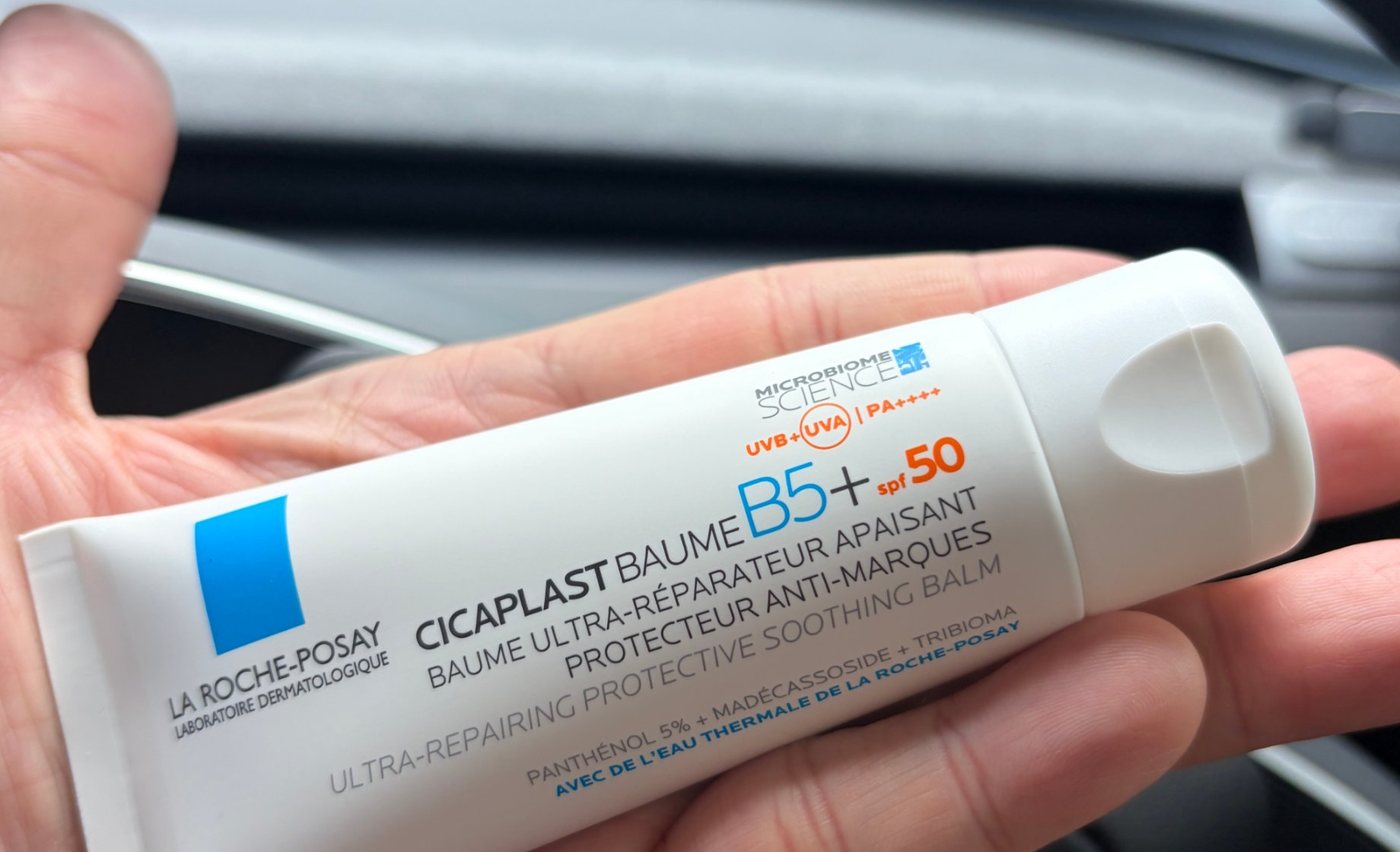
Now the specific example. I use La Roche-Posay Cicaplast Baume B5+ SPF 50 most days, and I want to explain what is in it rather than how it feels.
What the filter system actually is
Working through the published ingredient list, the UV filters are:
Bis-ethylhexyloxyphenol methoxyphenyl triazine, broad spectrum with substantial UVA coverage.
Ethylhexyl triazone, a strong UVB filter.
Butyl methoxydibenzoylmethane, avobenzone, for UVA.
Diethylamino hydroxybenzoyl hexyl benzoate, a dedicated UVA filter.
Phenylbenzimidazole sulfonic acid, water-soluble, UVB.
Terephthalylidene dicamphor sulfonic acid, a photostable UVA filter.
Six filters, four of which contribute UVA protection. That is a genuinely UVA-weighted system rather than an SPF number propped up by UVB filters, and it is the main reason I use it. Several of those filters are simply unavailable in American formulations.
The repair side of the formulation
The product is not primarily a sunscreen. It is a barrier repair balm that has had a filter system added, and the repair actives are the reason it exists.
Panthenol appears third on the list, ahead of the filters, and the brand states five per cent. Panthenol converts to pantothenic acid in the skin and has a reasonable literature behind it for barrier support and reducing transepidermal water loss. A 2002 review in the American Journal of Clinical Dermatology summarised its use across skin disorders, and a 2022 review examined the evidence specifically in atopic dermatitis.
Centella asiatica leaf extract and madecassoside. Madecassoside is one of the triterpenes from Centella and the component most associated with its wound healing activity. Systematic review work on Centella in wound healing exists, and a 2024 review in Pharmaceutics examined mechanisms and clinical efficacy. The honest summary is that the mechanistic and preclinical evidence is reasonably good and the clinical trial evidence in cosmetic use is thinner than the marketing implies.
Glycerin, second on the list, which is an unglamorous and genuinely effective humectant.
Zinc gluconate and manganese gluconate, included for their role in barrier function and skin repair.
Alpha-glucan oligosaccharide and a Vitreoscilla ferment, included as prebiotic and microbiome-supporting components, where the evidence is early.
Why I use it
Specifically: it suits post-procedure skin, and that is most of my working day.
After a peel, after laser, after microneedling, the skin barrier is compromised and photoprotection matters more than usual, at exactly the moment most sunscreens sting. A formulation built as a repair balm first, with a strong UVA filter set added, solves two problems with one step. The panthenol concentration ahead of the filters in the list is not accidental.
It is also fragrance free, which matters on reactive skin.
What it does not do, and this is the important part
It contains no iron oxides and it is not tinted. It therefore offers no meaningful visible light protection.
Given everything in the earlier section, that is a real limitation and I would rather state it than let a positive review imply otherwise. For a patient whose primary concern is melasma or recurrent post-inflammatory pigmentation, this is not the right product to rely on alone. A tinted mineral sunscreen with iron oxides is the better choice for that specific indication, and I say so in clinic regularly.
It contains alcohol denat. reasonably high in the list, which some reactive skin will not tolerate.
It is a balm. Thicker than most people want all over the face in Malaysian humidity. I use it on areas that need it rather than as an all-over base in the middle of the day, and anyone with acne-prone or very oily skin should approach a balm texture cautiously.
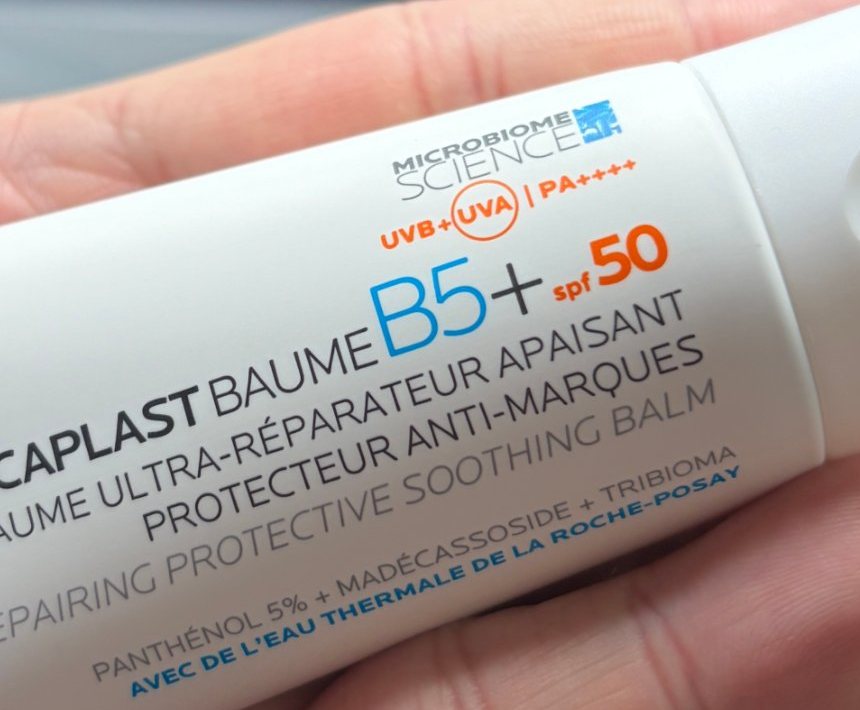
And the UVA rating depends on which pack you are holding. The published UK product page gives no UVA-PF figure and no UVA logo, so from that page alone I would be inferring protection from the filter list rather than reading a stated figure. The tube sold here prints it on the front: a circled UVA mark alongside PA++++, which is the top step of that scale. Check your own packaging rather than a website written for another market. It is a small instance of the larger habit this article is arguing for.
One further note. It is marketed and indicated as a repair balm for irritated skin, chapped lips, minor injuries and dry patches, including in children. Using it as a daily facial sunscreen is a reasonable off-label personal choice for my skin and my working day. It is not what the product is sold for, and I would not present a personal habit as a clinical recommendation.
What I would actually suggest
Rather than a product, a set of criteria.
If your main concern is pigmentation, melasma or marks after acne: a tinted sunscreen containing iron oxides, applied daily and reapplied. The tint is doing real work, not cosmetic work.
If your main concern is photoageing and you tolerate most things: a broad spectrum product with a strong UVA filter set, in a texture you will genuinely use daily.
If your skin is reactive, or you are recovering from a procedure: a barrier-supporting formulation, fragrance free, mineral filters if chemical filters sting.
If you are acne prone: a light fluid or gel rather than a balm or cream.
And for everyone here: reapply. The gap between the SPF on the bottle and the protection on your face at three in the afternoon is the largest avoidable problem in photoprotection, and no formulation fixes it.
The short version
At this latitude there is no low season, so photoprotection is a daily habit rather than a seasonal one.
SPF describes burning, not UVA, and not visible light. For Malaysian skin where the main concern is pigmentation rather than sunburn, visible light protection from iron oxides matters, and a clear sunscreen of any SPF does not provide it.
Read the filter list. Four of the six filters in the product discussed above contribute UVA protection, which is why I use it on post-procedure skin. It is also untinted, which is precisely why it is not the product I would hand to a patient whose main problem is melasma.
The best sunscreen is still the one you will apply every morning and reapply at lunchtime.
Book a consultation
If pigmentation, melasma or marks after acne are your main concern, the useful first step is working out which of those you actually have, since they behave differently and respond to different treatment. Our account of how melasma behaves differently from other pigmentation, and why that changes the treatment entirely, is here.
Book a consultation with Dr. Farah Izzati at AOKLINIK Penang.
References
- MetMalaysia readings reported in The Star, UV Index to hit extreme levels, 8 August 2026 thestar.com.my
- Hughes MCB et al. Sunscreen and prevention of skin aging: a randomized trial. Annals of Internal Medicine, 2013 read.qxmd.com
- Near-visible light and UV photoprotection in the treatment of melasma: a double-blind randomized trial pubmed.ncbi.nlm.nih.gov
- Impact of iron oxide containing formulations against visible light induced skin pigmentation in skin of colour individuals, Journal of Drugs in Dermatology jddonline.com
- Prevention of melasma relapses with sunscreen combining protection against UV and short wavelengths of visible light: a prospective randomized comparative trial canfieldsci.com
- Ebner F et al. Topical use of dexpanthenol in skin disorders. American Journal of Clinical Dermatology, 2002 pubmed.ncbi.nlm.nih.gov
- Use of Dexpanthenol for Atopic Dermatitis, benefits and recommendations based on current evidence, 2022 ncbi.nlm.nih.gov
- Topical Application of Centella asiatica in Wound Healing: Recent Insights into Mechanisms and Clinical Efficacy, Pharmaceutics, 2024 ncbi.nlm.nih.gov
- A Systematic Review of the Effect of Centella asiatica on Wound Healing ncbi.nlm.nih.gov
- La Roche-Posay published ingredient list, Cicaplast Baume B5 SPF 50 laroche-posay.co.uk
Frequently asked questions
Both provide substantial protection when applied properly, and the difference between them is smaller than the difference between applying enough and applying too little. Given UV index readings reaching the extreme band here, a higher SPF gives more margin for the under-application everyone is guilty of.
No. SPF reflects protection against burning, which is largely UVB. UVA protection is indicated separately by a UVA logo or PA rating, or inferred from the filter list.
Because the tint usually comes from iron oxides, which provide some protection against visible light. Visible light induces pigmentation in darker skin and conventional UV filters do not block it.
UVA passes through window glass, and visible light sources are everywhere. If you sit near a window, yes. The evidence for screen light specifically driving pigmentation is weak, so I would not worry about your laptop.
Not as your main protection. The amount applied is usually far below the quantity used in SPF testing. It is a reasonable top-up, not a base layer.
For some skin, yes, particularly dry or compromised skin. For oily or acne-prone skin in Malaysian humidity, a lighter fluid is generally more realistic and more likely to be used consistently.
There is randomised trial evidence. A trial in Queensland over four and a half years found measurably less photoageing in the daily use group than the discretionary use group, assessed objectively. ---